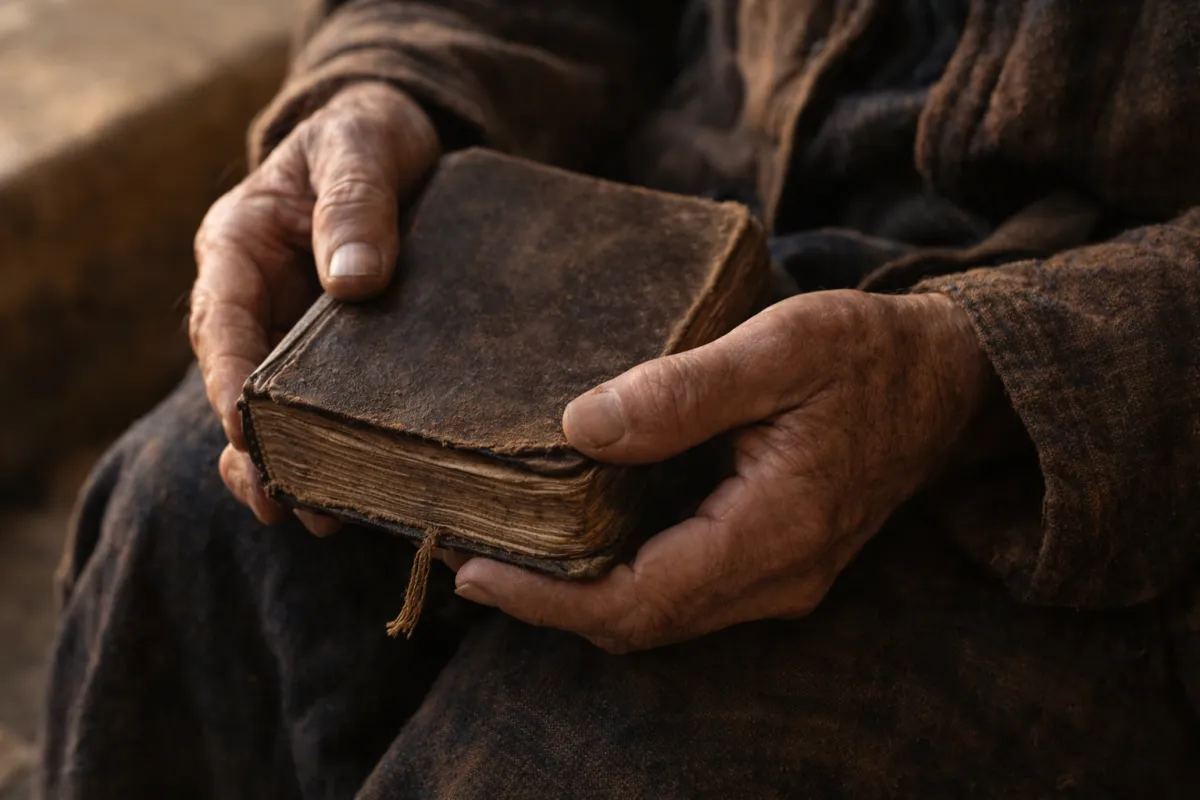
Where Should I Start Reading the Bible? A Guide for New Believers
Where Should I Start Reading the Bible? A Guide for New Believers
Topic: Starting the Bible | Audience: New Believers & Seekers
Start with the Gospel of John. It was written specifically so that you might believe — John says so himself in chapter 20, verse 31. It is not the first book in the New Testament, but it is the clearest introduction to who Jesus is, why he came, and what it means to follow him. If you have never read the Bible before, John is the door.
"But these are written, that ye might believe that Jesus is the Son of God; and that believing ye might have life through his name."
— John 20:31 (KJV)
The Bible is not a small book. Sixty-six books, written across thousands of years, spanning poetry and prophecy, law and letter, history and apocalypse. A reader approaching it for the first time may rightly wonder where to set foot first.
The instinct to begin at Genesis is understandable — it is, after all, the beginning. But Genesis was written to an ancient people, steeped in assumptions the modern reader does not share. Its genealogies are long. Its customs require explanation. And the One to whom all of it points does not appear in the flesh until the New Testament opens.
There is a wiser door for the one who wishes to know God: the Gospel of John.
Why John?
The Apostle John wrote his Gospel late in life, after decades of reflection on what he had witnessed. He had walked with Jesus. He had leaned against him at the Last Supper. He had stood at the foot of the cross. When he finally set pen to paper, he did not attempt a biography. He constructed a case — a deliberate, theological argument for the identity of the man he had known.
His purpose is stated without ambiguity: "These are written, that ye might believe that Jesus is the Son of God; and that believing ye might have life through his name" (John 20:31).
John is not concerned with completeness. He is concerned with belief. He selects his material — miracles, discourses, confrontations — with the precision of a lawyer building toward a verdict. The verdict he seeks is faith.
Matthew Henry observed that John's Gospel contains "the clearest proofs of Christ's divine nature" and presents Jesus not merely as a teacher or prophet, but as the eternal Word made flesh. If you want to understand who Jesus claimed to be — and why that claim matters — John is where you begin.
What You Will Find There
John opens unlike any other Gospel. There is no genealogy. No manger. No shepherds. Instead, a theological declaration that frames everything to follow:
"In the beginning was the Word, and the Word was with God, and the Word was God."
This is not the record of a wise teacher who gathered followers. This is the account of God entering his own creation — the Word taking on flesh and dwelling among men. From this opening line through the resurrection, John will present sign after sign, discourse after discourse, each one pressing the same question: Who is this man?
You will encounter Nicodemus, a Pharisee who came by night and heard the words "Ye must be born again." You will meet the Samaritan woman at the well, who found herself known by a stranger who offered living water. You will hear Jesus declare "I am the bread of life," "I am the light of the world," "I am the resurrection and the life."
Each chapter builds upon the last. Each sign points beyond itself. And by the time you reach the empty tomb, the evidence will have accumulated into a single, unavoidable conclusion — the one John intended from the first verse.
A Simple Path Forward
You do not require a formal reading plan to begin. But if structure aids discipline, consider this: read one chapter of John per day. Twenty-one chapters. Three weeks. There is no need for haste. Let each chapter settle before moving to the next.
If a verse arrests you, stop. Read it again. Pray over it — even if prayer feels unfamiliar. The goal is not speed. The goal is encounter.
Charles Spurgeon wrote: "The Scriptures are the swaddling bands of the holy child Jesus; unroll them and you find your Saviour." That is precisely what happens when you open the Gospel of John. You are unrolling the wrappings to find the One they contain.
"In the beginning was the Word, and the Word was with God, and the Word was God." — John 1:1
Before anything else, John establishes this: the man you are about to encounter is not merely a man. He was present at the creation of all things. He is the agent through whom all things were made. And he took on human flesh and entered the world he had spoken into existence. This is the weight of what you are reading.
APPLICATION
Three considerations for those beginning the Scriptures:
1. Enter through John, not Genesis. The Old Testament will yield its riches more fully once you have met the One to whom it points. Begin where the invitation is most direct — a Gospel written explicitly that you might believe.
2. Read aloud, and read slowly. The Apostle Paul wrote that faith comes by hearing (Romans 10:17). There is something in the spoken Word that lodges differently than the merely scanned. Let the text enter through your ears, not only your eyes.
3. Expect to be addressed. The Scriptures are not an artifact to be studied at a distance. They are living and active, sharper than any two-edged sword (Hebrews 4:12). The same Spirit who inspired their writing is present when you open them. Come expecting to be met — and you will be.
FAQ
Q: Where should I start reading the Bible as a beginner?
The Gospel of John is the most suitable entry point for a new reader. It was written with a stated purpose: that the reader might believe that Jesus is the Son of God, and that believing, might have life through his name (John 20:31). It offers the clearest presentation of Christ's identity, teaching, and mission. After John, the Gospel of Mark provides a brief, vigorous account of Jesus's ministry, and the book of Romans offers a systematic explanation of the Gospel and its implications.
Q: Why not begin reading the Bible at Genesis?
Genesis is foundational to the whole of Scripture, but it was composed for an ancient audience operating under assumptions unfamiliar to the modern reader. Beginning there means traversing genealogies, ceremonial laws, and prophetic poetry before arriving at the person of Christ. Starting with John allows the reader to encounter Jesus directly and then return to the Old Testament with understanding of what — and whom — it anticipated.
Q: How long does it take to read the Gospel of John?
The Gospel of John contains twenty-one chapters. At a pace of one chapter per day, a reader will complete it in three weeks. Read continuously, the entire book takes approximately two hours. However, the text rewards slow, meditative reading. Haste is not the aim; comprehension and encounter are.
Q: What should I do when I encounter passages I do not understand?
Continue reading. Understanding deepens with exposure. Pray before you begin and ask God to illumine the text. If a particular verse remains obscure, note it and proceed — later chapters frequently clarify earlier ones. A trusted commentary or a conversation with a pastor can also provide assistance. Do not allow confusion on one point to halt progress through the whole.
Q: Is there a Bible reading plan suited for beginners?
A simple and effective plan: read one chapter of John per day for twenty-one days. Then proceed to Romans, reading one chapter per day for sixteen days. After completing Romans, return to the other Gospels — Matthew, Mark, and Luke — to see the life of Christ from additional perspectives. This sequence establishes a firm foundation in the person of Jesus and the doctrine of salvation before expanding into the wider canon.
You are not the first to approach this book uncertain of where to begin. The question is as old as the Scriptures themselves — and the answer has not changed.
Twenty-one chapters. One chapter per day. Three weeks to meet the One the whole Bible is about.
Want to carry God's Word with you everywhere?
We are placing free Pocket New Testaments into willing hands — just cover $4.95 shipping.
